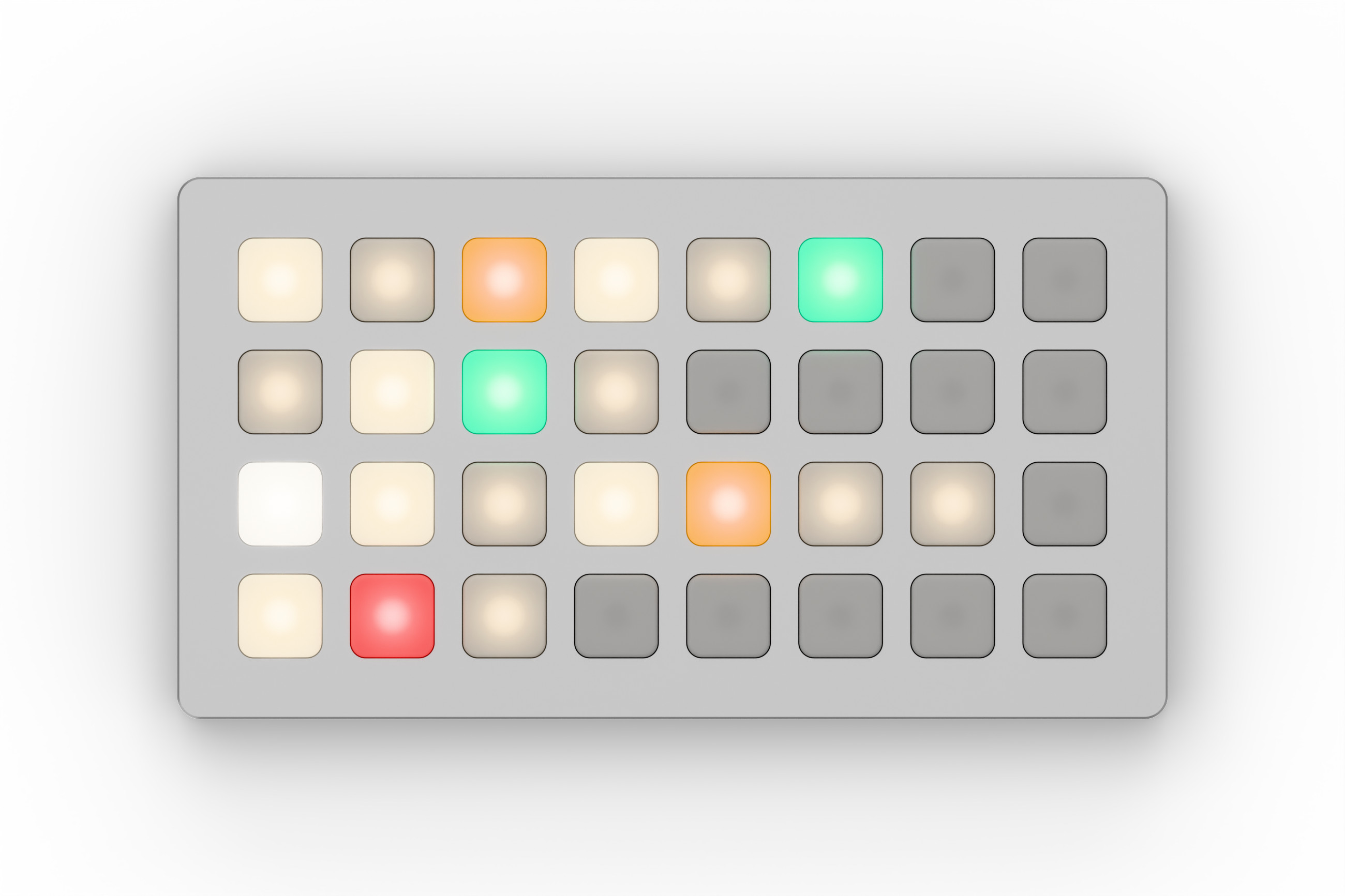
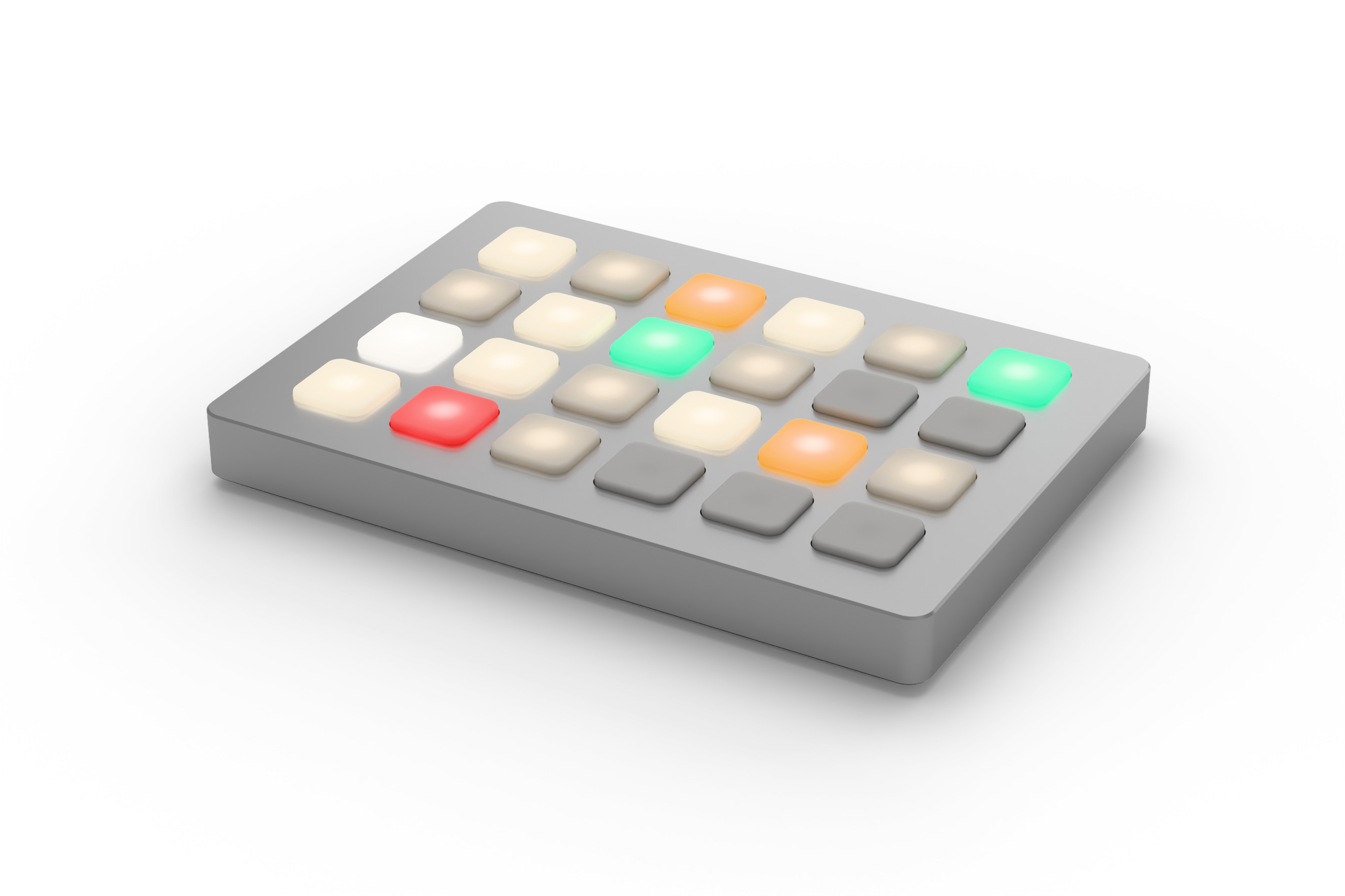
silver. 6061 bead-blast, clear anodise, milky white keys. the default.
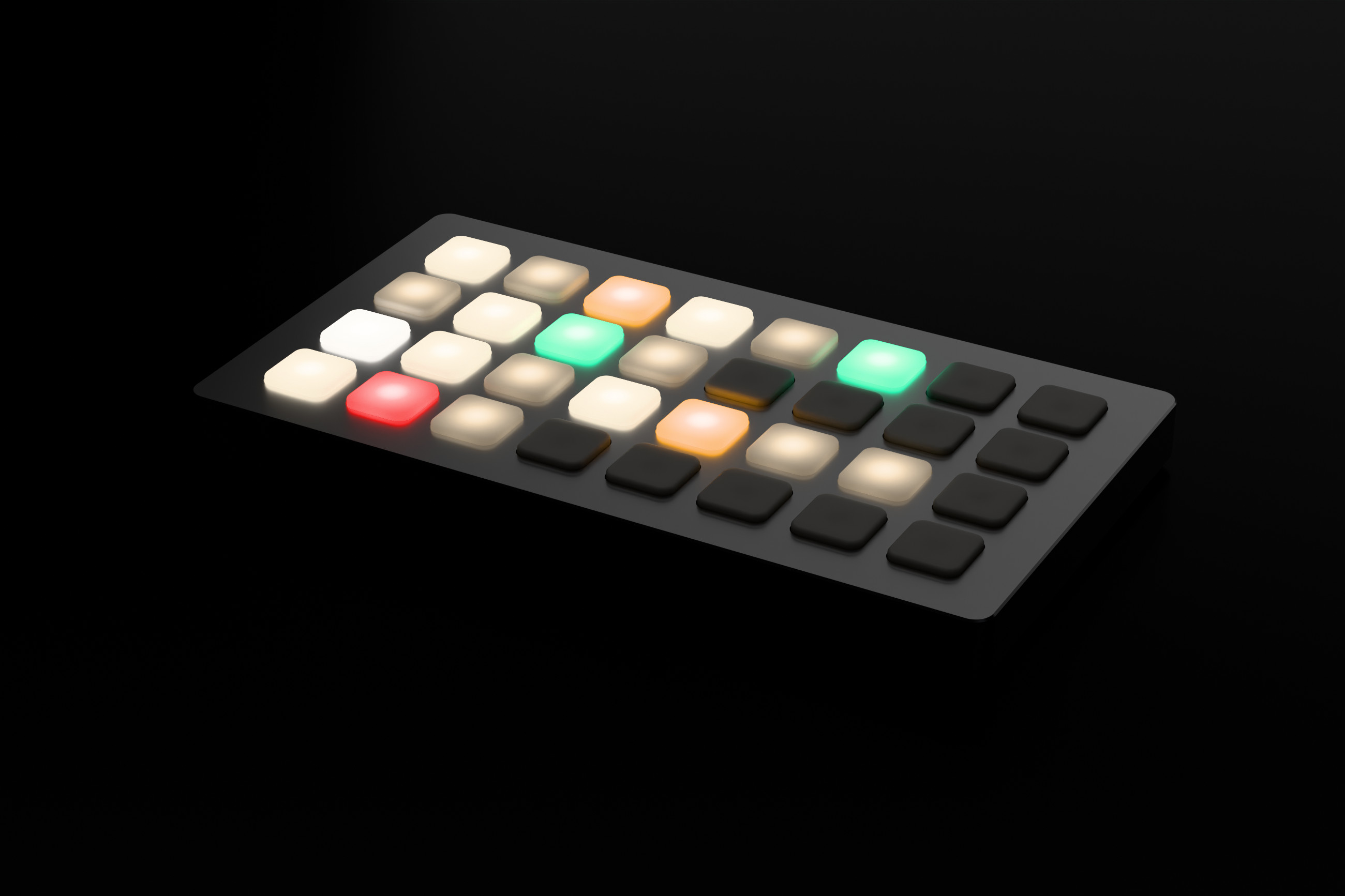
a desk control surface for agents. each key lights with the state of one terminal tab. first integration: rex by superlogical.
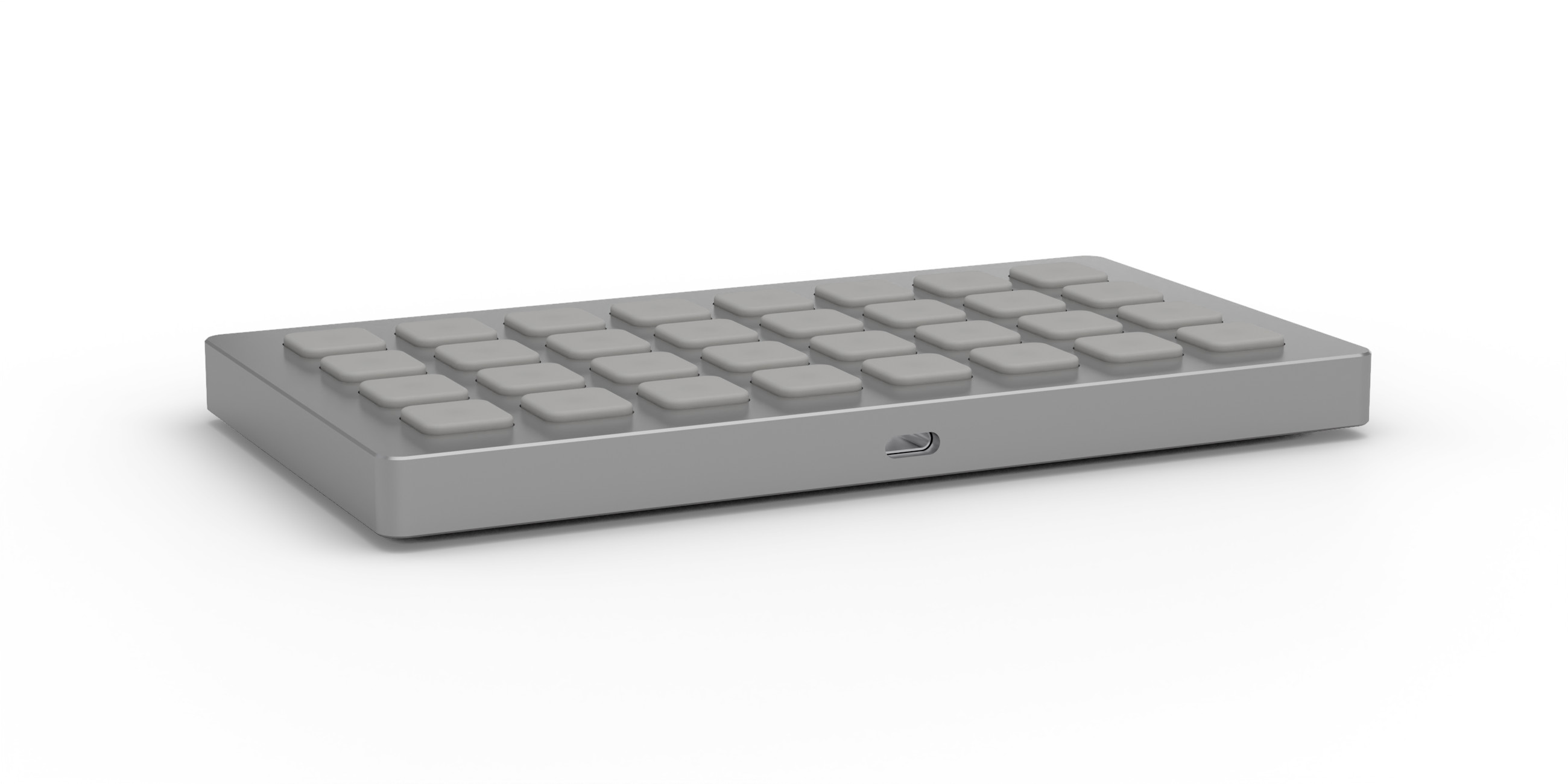
wired usb-c. no battery, no radio, no screen.
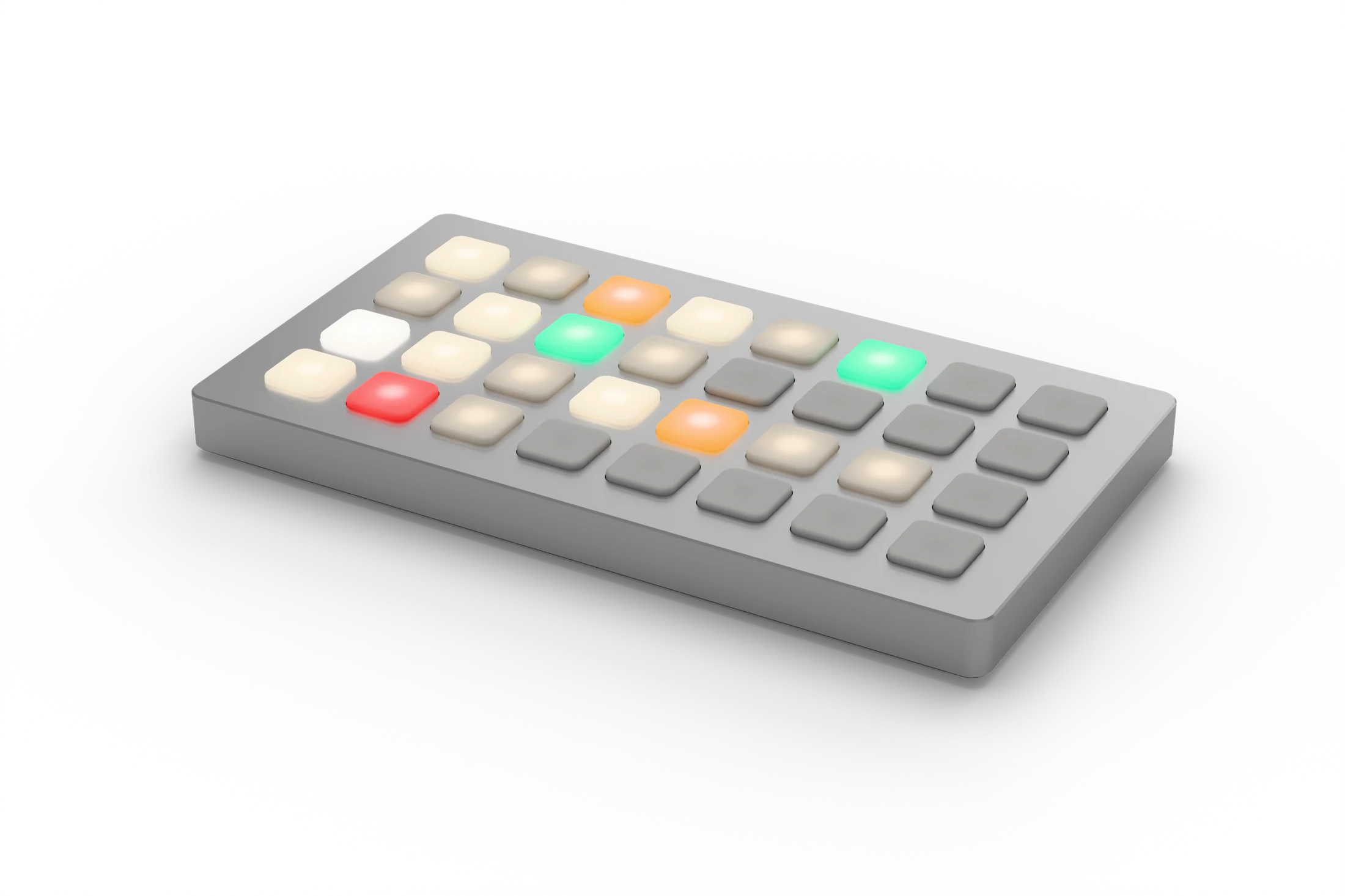
a row for every session, a key for every tab. press and you are there.
168 × 92 × 12 mm
394 g. 6061 aluminium on 304 stainless
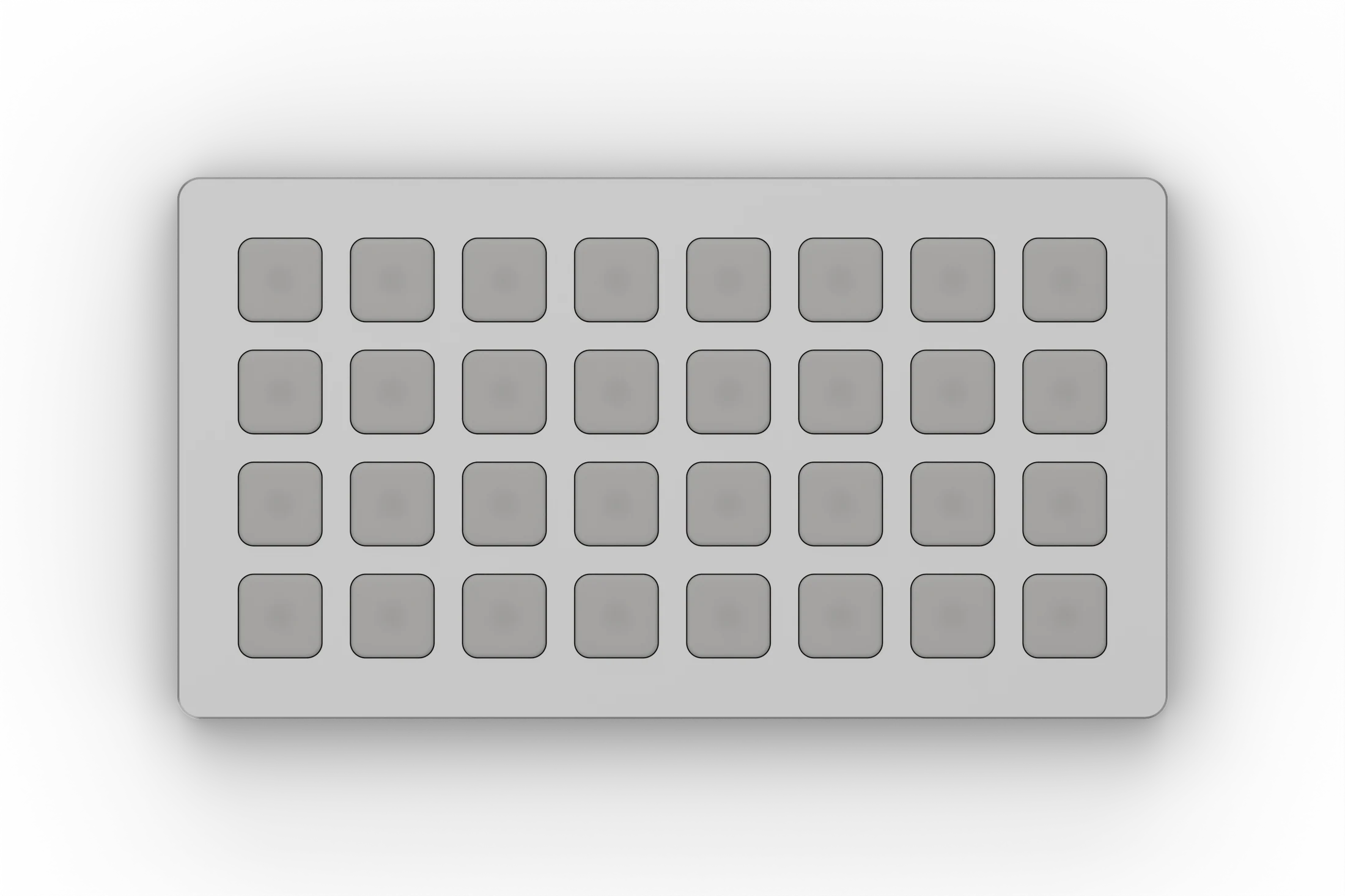
32 keys, an rgb led under each
one port, usb-c, bus powered
how it works
a row is a rex session: one project, such as web, api, ios or docs. four rows.
a key is a tab in that session, in tab order, lit with its state. eight to a row.
press a key and rex jumps to that session and tab. states come from rex program status records (osc 7501).
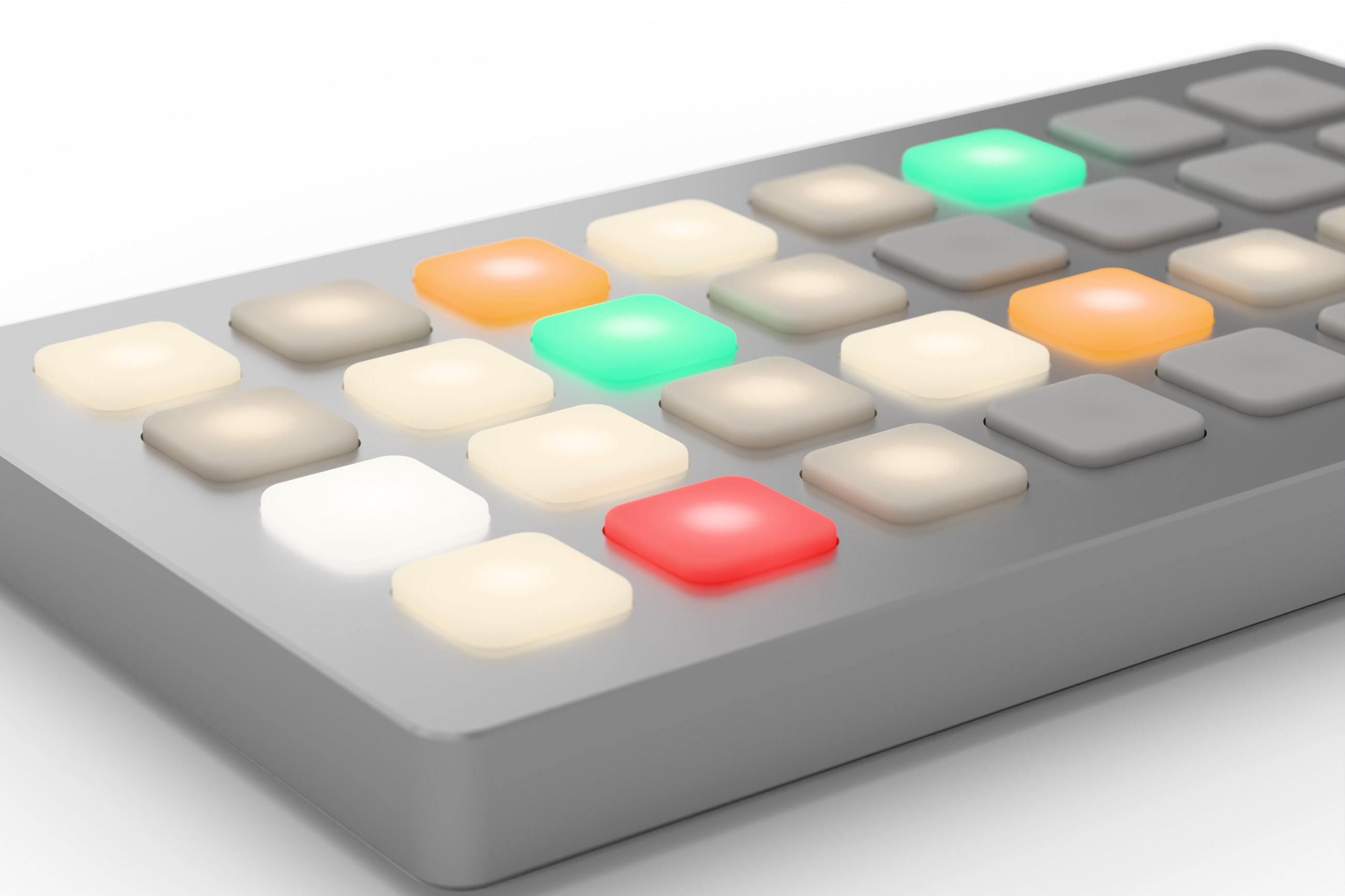
several panes in a tab: blocked > error > working > done > idle.
- key
none pressed yet- device sends
0x81 key [index, down]- rowd runs
rex -C client do session.select session_id=… window_id=…
light is the
interface
orange is the only colour that moves fast. if nothing is orange, nothing needs you.
motion is animated on the device. if the host goes quiet for 5 s it fades to one dim key.
form
a flat machined slab, heavy enough to stay put when pressed: an 84 g aluminium housing over a 225 g stainless base.
glass-bead blast and type ii clear anodise. milky translucent silicone keys, matte pu top coat, 1.5 mm proud.
no logo, no legends, no visible fasteners. one port, centred on the rear face.
168921914510.5r 4r 2.5
millimetres. 19 is the standard keyboard pitch. each cross is a key centre and an led. edges carry a 0.4 chamfer.
1213.515.7
12 mm body, 13.5 with keys, 15.7 with feet.
compact 4 × 6. 130 × 92 × 12 mm, 308 g, 24 keys. needs its own keypad tool (+~$2,000) and pcb. housing ~15–20% cheaper.
lite. mjf pa12 nylon housing, dyed grey, on the same base, keypad and pcb. housing ~$8–12 instead of $26–42. not rendered.
inside
seven layers, four screws, nothing glued but the feet. about 4.5 minutes to assemble, flash and test.
housing face down, then keymat, pcb, 4 spacers, base plate, 4 screws, 4 feet.
parametric cad in cad/row.py. step files per part and assembly in cad/out_4x8 and cad/out_4x6, ready to quote.
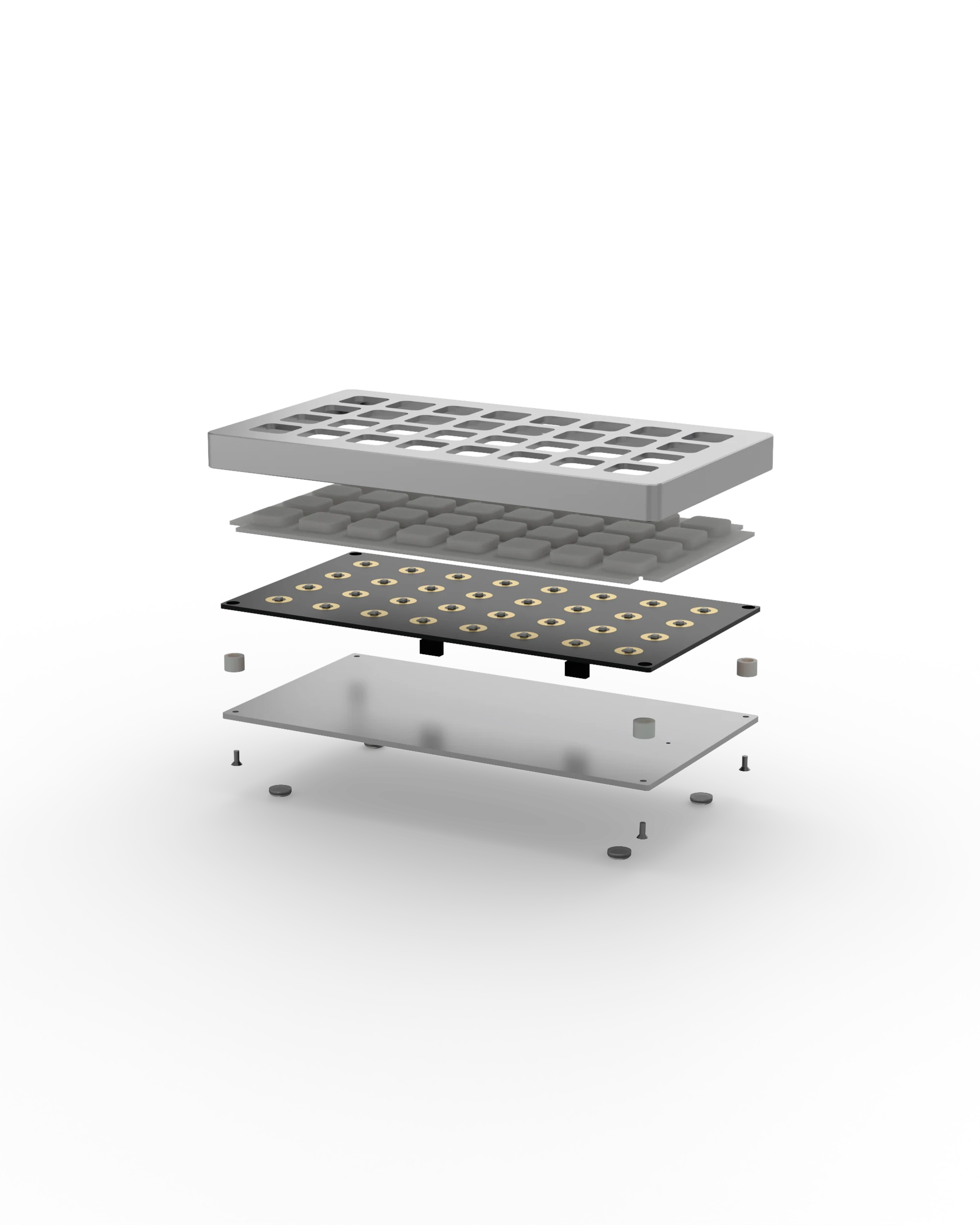
1 housing
6061-t6, 3-axis cnc, 2 setups (+1 for the usb slot). 2.0 mm top wall, 2.5 mm side walls, 32 apertures of 14.4 mm, 4 corner bosses with m2 threads.
z 0–12.0 mm
2 keymat
one-piece compression-moulded silicone, 60 shore a, translucent. 1.4 mm web, 0.4 mm dome membrane, carbon ring contacts, 1.2 mm travel, ~120 gf.
z 8.6–13.5 mm
3 pcb
162.2 × 86.2 × 1.6 mm fr4, 2-layer, enig, black mask. leds and contact pads on top, everything else underneath.
z 7.0–8.6 mm
4 spacers × 4, support pads × 2
nylon spacer ø7 × 5.0 (m4 clearance), poron pads. clamp the pcb up against the housing shoulders.
z 2.0–7.0 mm
5 base plate
2.0 mm 304 stainless, laser cut, bead blast. recessed inside the housing walls, flush. 1.5 mm bootsel pinhole.
z 0–2.0 mm
6 screws × 4
m2 × 5 countersunk torx t6, a2 stainless (iso 14581). the only fasteners.
z 0–5 mm
7 feet × 4
3m bumpon sj5302, clear pu, ø7.9 × 2.2. adhesive.
z −2.2–0 mm
z from the desk side of the base plate.
electronics. 20 bom lines, 129 placements a board.
| mcu | raspberry pi rp2040 (qfn-56) + w25q16jv flash + 12 mhz crystal | $0.85, native usb, pio drives the led chain, drag-and-drop uf2 firmware updates, free usb pid from raspberry pi |
|---|---|---|
| leds | 32 × worldsemi ws2812c-2020-v6 (2 × 2 mm, 5 ma per channel) | one under each key, single data line, low current so the whole grid fits in a usb 2.0 500 ma budget |
| level shift | sn74ahct1g125 | 3.3 v data to 5 v led chain |
| keys | 4 × 8 matrix, 32 × 1n4148ws diodes, carbon ring on interdigitated enig pads | no mechanical switches, full n-key rollover, 1 khz scan |
| usb | 16-pin usb-c 2.0 receptacle (hro type-c-31-m-12), 2 × 5.1 k cc, usblc6-2sc6 esd, 0.75 a ptc, ferrite | bus powered |
| power | ap2112k-3.3 ldo | 3.3 v rail |
| boot | bottom tact switch behind a pinhole | recovery only; normal updates are over usb |
~530 ma worst case. 32 leds full white (480 ma) + ~50 ma mcu.
435 ma firmware limit. each frame is summed and scaled to stay under 380 ma of led current.
< 100 ma before enumeration. until the host enumerates.
< 80 ma typical desk use. a few lit keys.
wireless
a study for a second version. buildable in the same body, a different product economically. ship wired first.
what changes
| wired v1 | wireless | |
|---|---|---|
| mcu, radio | rp2040 | raytac mdbt50q-1mv2 module (nordic nrf52840): bluetooth le 5.4, 2.4 ghz proprietary and native usb, pre-certified fcc / ic / ce-red / telec, 10.5 × 15.5 × 2.05 mm. replaces the rp2040, flash and crystal. |
| power | usb bus | 1,200 mah lipo pouch (jauch lp305166jh, 66 × 51.5 × 3.3 mm, protected) in the 5.0 mm cavity under the pcb. bq24074 charger with power path, max17048 fuel gauge, tps62840 3.3 v buck, tps61023 5 v boost for the leds, tps22917 load switch on the led rail. |
| enclosure | closed aluminium and steel | needs an rf window. |
| usb-c | data and power | charging, firmware, and wired fallback: works as v1 when plugged in. |
| weight | 394 g | ~415 g |
nrf54l15 and esp32-c6 modules have no usb device, so they cannot be the single mcu. esp32-s3 has usb but idles far higher on ble.
light costs power. the radio is almost free; the leds are not.
- ~110 days
- all keys dark, led rail switched off, ble connected
- ~15 hours
- typical desk use: about 7 keys lit, mixed states
- ~13 hours
- leds at ~10% average across all 32
- ~1.3 hours
- all 32 at full white
- ~2.5 days
- leds dark but rail left on: 32 idle ws2812c draw up to 16 ma, so the rail must be gated
est., on 1,200 mah at 80% usable. cordless for a working day or two, charged overnight, not weeks on a charge. it dims and gates the led rail when the host sleeps.
aluminium closed by steel is a shielded box. the 14.4 mm key apertures are far too small for 2.4 ghz: a window wants about 62 mm, half a wavelength (antenova guidance).
abcd
underside, rear edge up. positions indicative. a usb-c, b rf window, c module, d battery.
- 1a glass-filled polycarbonate window let into the rear strip of the base plate, about 64 × 12 mm, colour-matched, with the chip antenna of the module over it. invisible from above. radiates down and back; expect 3–6 db loss, fine for a 1–2 m desk link. must be measured on a prototype.
- 2a polymer band across the rear wall, like the antenna band on a tablet. best rf, but a visible seam.
- 3an external adhesive antenna on a u.fl module behind the window, only if 1 fails. it must stay within the antenna type on the grant of the module.
a slot cut in the housing as the antenna would be a custom radiator and loses the pre-certification.
bluetooth or a dongle
| bluetooth le | 2.4 ghz usb dongle | |
|---|---|---|
| pairing | os pairing, no dongle, works with laptops directly | plug in dongle, no pairing |
| one-off fee | bluetooth sig qualification $12,000, fee schedule effective 1 mar 2026. no small-company discount since 2020. a pre-qualified module removes testing, not the fee. | none |
| unit cost | none | +$9–12 for a custom dongle, est. |
| compliance | red on the product | red on the product and fcc/red on the dongle |
| break-even | cheaper above ~1,000 units | cheaper below ~1,000 units |
the same nrf52840 hardware does both, so the dongle can ship first and bluetooth follow as firmware once volume justifies the fee.
what wireless adds, usd
| per unit, at a batch of | 50 | 100 | 250 | 500 |
|---|---|---|---|---|
| module, less rp2040, flash and crystal | 4.85 | 4.85 | 4.50 | 4.20 |
| battery, jauch from digikey | 8.80 | 8.20 | 7.60 | 7.10 |
| charger, fuel gauge, boost, buck, load switch, passives | 7.45 | 7.18 | 6.76 | 6.60 |
| rf window, battery fitting, extra test | 4.25 | 4.25 | 3.70 | 3.10 |
| wireless adds | +$25.4 | +$24.5 | +$22.6 | +$21.0 |
| low case: generic certified cell ~$3.50, lcsc fuel gauge | +18 | +17 | +15.5 | +14.5 |
| optional custom dongle | +9–12 | +9–12 | +9–11 | +9–10 |
| one-off | bluetooth | dongle only |
|---|---|---|
| bluetooth sig qualification | 12,000 | 0 |
| eu red radio, emc and battery safety (en 300 328, en 301 489, en 62368-1), fcc host checks | 3,500–12,000 est. | 4,500–14,000 est., two devices |
| antenna tuning and pre-scan | 1,000–3,000 est. | 1,000–3,000 est. |
| en 18031 cybersecurity scope opinion | 0–1,500 est. | 0–1,500 est. |
| total on top of wired | ~$17,000–27,000 | ~$5,500–18,500 |
| per unit at 100 / 500 | $170–270 / $34–54 | $55–185 / $11–37 |
it ships as un3481, lithium battery contained in equipment, at 30% charge or less. ce is accepted in great britain for radio equipment. firmware moves from the rp2040 sdk to zephyr.
1. v1 wired. one cable, no battery, no radio, no shipping restrictions, ~$49–83 a unit.
2. design v1 so v2 is a board swap. the 5.0 mm cavity already fits the 3.3 mm cell and the 2.05 mm module; only the base plate and pcb change.
3. v2 with a 2.4 ghz dongle first, bluetooth by firmware later, once volume passes ~1,000 units and the $12,000 fee costs less than a dongle.
api
three layers. the device is dumb on purpose: it shows frames and reports keys. all meaning lives on the host.
device. usb raw hid, usage page 0xff60, 64-byte reports.
| 0x01 set_frame | host→dev | 32 × [r, g, b, anim] | whole grid. anim: 0 solid, 1 breathe, 2 pulse. animated on-device, so no host traffic for motion. |
|---|---|---|---|
| 0x02 set_key | host→dev | [index, r, g, b, anim] | one key. |
| 0x03 set_brightness | host→dev | [0–255] | global, capped by the current limiter. |
| 0x04 get_info | host→dev | no bytes | returns firmware version, rows, cols, serial. |
| 0x81 key | dev→host | [index, down] | key event. index = row × 8 + col. |
| 0x7f bootloader | host→dev | magic | reboot to uf2 drive. |
host. rowd, in daemon/rowd.py: stdlib python, working today against live rex 0.1.0, api revision 11.
rowd snapshot                                              # current grid as json
rowd sim                                                   # live terminal simulator, no hardware
rowd press 4 2                                             # same as pressing row 4, key 2
rowd run                                                   # drive a real device over hid

rex ls --json                                              # sessions -> rows
rex window ls -s session --json                            # tabs -> keys, active_window_id -> focus
rex block call -s session -b block program_status          # idle | working | done | blocked | error
rex events --json                                          # push updates (program_status_changed, bell, …)
rex -C client do session.select session_id=… window_id=…   # key press -> jump to tab

web  [focus] [done] [idle] [done]                          # a snapshot
api  [done]  [done] [focus]
ios  [focus]
docs [done]  [working] [working]
local api for other tools, planned. unix socket and http on 127.0.0.1:7769.
GET  /v1/grid                 -> rows, keys, states
PUT  /v1/keys/{row}/{col}     {"state":"blocked"} or {"rgb":[255,64,0],"anim":"pulse"}
POST /v1/rows                 {"source":"rex","session":"docs"}   pin a session to a row
GET  /v1/events  (sse)        key down/up, state changes
rex first. tmux, zellij, claude code hooks (notification, stop) and cursor background agents are thin adapters. any program can light its own key by printing the status escape rex already understands, osc 7501.
$69.04 a unit
in a batch of 100
batch
an estimate, about −25% / +45%. almost all of the doubt is the housing and keypad, which no vendor prices publicly.
- in gbp
- £52, at 0.75
- electronics
- $9.16, £6.87
- mechanical, box, freight, assembly
- $59.88, £44.91
- batch, units only
- $6,904, £5,178
- with $2,600 tooling and prototypes
- $95 a unit
- with ~$9,000 incl. emc testing
- $159 a unit
- uk import duty, not included
- ~$2.20 a unit
electronics, per unit, jlcpcb assembled
| rp2040 | lcsc c2040 | 0.855 | |
|---|---|---|---|
| w25q16jvssiq flash | lcsc c131025 | 1.048 | digikey marks obsolete; alt w25q32jvssiq c179173 |
| 12 mhz crystal | lcsc c9002 | 0.076 | |
| ws2812c-2020-v6 × 32 | lcsc c55109522 | 1.760 | v1 is out of stock; v6 is the maker's successor |
| 1n4148ws × 32 | lcsc c2128 | 0.246 | |
| sn74ahct1g125 | lcsc c7484 | 0.080 | |
| usb-c type-c-31-m-12 | lcsc c165948 | 0.148 | |
| usblc6-2sc6 | lcsc c7519 | 0.124 | |
| ap2112k-3.3 | lcsc c51118 | 0.129 | |
| ptc, ferrite, tact, passives (~56 pcs) | lcsc basics | 0.24 | |
| components | 129 placements | 4.71 | |
| smt assembly, double-sided; setup, stencil and feeders amortised | jlcpcb.com | 2.55 | fees, incl. conditional fixture fees |
| bare pcb 160 × 84, 2-layer enig | jlcpcb.com | 1.90 | needs gerber upload. est. |
| electronics total | 9.16 |
mechanical, per unit
| housing, cnc 6061, bead blast + anodise | jlccnc; rfq rapiddirect at 250+ | 36.00 | from published shop rates and comparable one-off keyboard cases. range $30–65 @50, $18–40 @500. est. |
|---|---|---|---|
| base plate, 2 mm 304 | same order, jlccnc | 4.00 | est. |
| silicone keypad | niceone-tech; price check rysilicone | 8.00 | vendors confirm 1-pc moq, 15–22 day lead. est. |
| screws × 4, m2 torx csk a2 | westfield fasteners (uk) | 0.30 | from box price. est. |
| feet × 4, 3m sj5302 | digikey | 0.63 | |
| spacers + pads | lcsc / rs | 0.35 | est. |
| usb-c cable, 1 m braided | alibaba listing | 1.30 | $1.10 + freight |
| box + insert | packlane (50–250), alibaba rigid box (500) | 4.50 | read at 250, rest est. |
| freight china → uk, express, ~0.45 kg per set | 2.80 | est. | |
| assembly + test, in-house, 6 min | 2.00 | est. | |
| mechanical total | 59.88 |
usd. prices not marked est. were read from the supplier on 11 nov 2026.
one-off, the same at any batch
| silicone keypad compression tool | $2,000 (range $1,000–3,500) | from vendor-published ranges: rysilicone $800–3,000; ssi $2,000–5,000; diamond hmi uk £2,500–4,000. est. |
|---|---|---|
| prototype round: 3 housings, 5 pcbas, first-article keypads | ~$600 | est. |
| usb product id | $0 | raspberry pi pid programme (vid 0x2e8a). avoids the $6,000 usb-if vendor id |
| emc testing: en 55032/55035 (ukca + ce) + fcc 15b sdoc | £3,000–6,500 (~$4,000–8,700) | uk labs: kiwa, element, tüv süd, eurofins. only needed to sell, not to build for yourself or friends. est. |
| uk weee small-producer registration | £30 per year | |
| total | ~$2,600 to build | ~$6,600–11,300 to sell legally in uk, eu and us |
10–12 weeks from released drawings to 100 boxed units, one prototype round included.
- 4–5 weeks
- keypad tool + first articles
- 3–4 weeks
- then bulk keypads
- 2–3 weeks
- housing
- 1–2 weeks
- pcba
for a firm number in minutes, upload cad/out_4x8/housing.step to jlccnc.com and xometry.com. a us or eu machined housing adds roughly $34–53 a unit. import vat, 20%, is reclaimable if vat registered.
open risks, to close on the first prototype
- 1ring carbon contacts are non-standard. get actuation force and contact resistance in writing. fallback is a screen-printed carbon ring.
- 2light bleed between keys through the silicone web. black back-print on the web is specified. verify on first articles.
- 3cosmetic yield on bead-blast + anodise. agree an a-surface standard and golden sample before the batch.
- 4ws2812c-2020-v6 pad order vs v1 footprint. check against the v6 datasheet before releasing the pcb.
- 5blind m2 threads in the corner bosses (1.1 mm wall). confirm with the machinist or switch to thread-forming screws.
- 6pcb layout and firmware are specified but not yet drawn or written. schematic-level design, bom and protocol are done. kicad layout is the next step.
identity
the o is one key: 14 square, 2.5 corner. the space to the w is the 5 mm gap between keys. strokes 4, counters 6.
aba